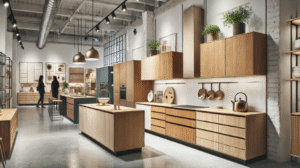
Walk into a beautifully merchandised store and you’ll feel it before you can name it: warmth, order, and an effortless sense of style. That’s the power of environment on behavior—and it’s why the fixtures you choose matter as much as the products you sell. Mid-Century Modern (MCM) kitchen cabinets—think clean lines, real (or convincing) woodgrains, integrated pulls, and human-scaled proportions—are quietly becoming a secret weapon for retailers that want to elevate experience, move more product, and telegraph quality without shouting. Although they originated in the home, MCM cabinets translate brilliantly to retail as cash wraps, back-of-house storage, service bars, fitting-room consoles, beauty backbars, and front-of-house display runs. Done right, they help you create zones, reduce visual noise, and stage irresistible moments that encourage discovery and purchase.
Below, we unpack why Mid-Century Modern kitchen cabinets are a smart, scalable, and surprisingly cost-effective path to a stronger brand presence and better results—no demolition required.
The Aesthetic Advantage: Warm Minimalism That Sells
Minimalism is great for focus; warmth is great for comfort. MCM marries both. Walnut and teak tones (or durable laminates in the same palette) soften a space, while flat fronts and geometric symmetry keep sightlines clean so the merchandise pops. In practical retail terms, that means fewer distractions, better product storytelling, and a store that feels organized even on your busiest days. The classic MCM vocabulary—horizontal grain, slim reveals, and furniture-like bases—also makes cabinets read as “movable” pieces rather than bulky built-ins, which customers subconsciously associate with boutique quality.
Retailers are doubling down on store experience for good reason: shoppers still choose brick-and-mortar for what they can see and touch in person. As Retail Dive reports, tactile, in-store experiences continue to win attention even as digital tools grow more sophisticated. MCM cabinetry supports that tactile moment—doors open smoothly, drawers glide, textures look real—so the entire encounter with your brand feels elevated. Retail Dive
Versatility Across Categories: One Language, Many Stories
Mid-Century cabinets are chameleons. Swap hardware, adjust toe-kicks, or vary heights and you can accommodate:
-
Apparel: Front runs with shallow upper cabinets become folded-denim walls; integrated drawers hide backstock by size.
-
Beauty & wellness: Narrow uppers and lit niches create “testing bars” with easy cleanup.
-
Home & lifestyle: Deeper bases support weighty goods (cast iron, candles, serveware) without visual heaviness.
-
Electronics & accessories: Cable-managed drawers keep demo units powered while countertops stay clutter-free.
-
Gourmet/food: Vertical tambour-style doors or fluted fronts echo MCM texture while meeting health-code wipe-down needs.
Because MCM is more “design language” than theme, you can evolve collections seasonally without rebuilding your fixture kit. That extends fixture life and reduces remodel risk—a big deal when budgets are tight and priorities change.
Visual Merchandising That Converts: Create Calm, Guide the Eye 🎯
Effective visual merchandising balances contrast (to make product stand out) with cohesion (to keep the store legible). MCM cabinets provide a calm, neutral canvas that makes colors, textures, and packaging sing—especially when you pair woodgrain bases with matte, museum-quiet countertops. Industry conversations continually highlight how in-store design nudges traffic flow and purchase behavior. The National Retail Federation has spotlighted how purposeful environments shape perception and decisions across the customer journey—exactly the kind of work great fixtures do behind the scenes. Read NRF’s perspective. National Retail Federation
Retailers and design teams also report that the right store experiences—supported by fixtures, lighting, and layout—maximize both dwell time and sales. Retail TouchPoints’ coverage of visual merchandising underscores how design activations and pop-ups rely on adaptable fixture systems to keep stores fresh. MCM cabinets, with their modular doors, drawers, and open bays, are perfect for quick re-sets without calling a contractor. Retail TouchPoints
Smart Storage, Faster Service: Hide the Chaos, Show the Brand
Retail work is part theater, part logistics. The front must look effortless while the back hums efficiently. MCM base cabinets double as “hidden helpers”:
-
Backstock at arm’s reach: Size runs, refills, and accessories live inches from the salesfloor—fewer trips to the stockroom.
-
Cable and tech management: Drilled grommets and routed channels hide chargers, tablets, label printers, and POS hardware.
-
Security, discretely: Locking drawers for high-shrink items or expensive accessories keep staff in control without glass cases that kill spontaneity.
-
Cleaning made easy: Durable laminates and sealed woods wipe clean fast, and integrated toe-kicks prevent dust bunnies on display.
The result? Associates spend more time with customers and less time hunting for inventory or fussing with clutter—key to better experiences.
Brand Storytelling Without Rebuilds: Materials That Speak
Mid-Century Modern is historically linked to optimism and progress. When you echo that heritage through your fixtures, you’re telling a story about your brand—timeless, quality-minded, confident. You can tune the story by material:
-
Walnut/teak woodgrains: Premium, cozy, heritage cues for footwear, denim, and home.
-
Smooth white/cream fronts: Gallery-like calm for beauty, apothecary, and wellness.
-
Muted color laminates (sage, clay, ink): Trend-aware sophistication for lifestyle and gift.
Add ribbed glass, fluted fronts, or cane-pattern door inserts to bring lightness and texture. Because the cabinet “box” stays constant, swapping doors or hardware refreshes the whole store for a fraction of a remodel.
Better Sightlines, Better UX: Human-Scaled Heights 🧰
Kitchen systems are engineered for human use, which makes them ideal for retail ergonomics. Counter heights (~36″) are naturally comfortable for checkouts, consultation bars, or styling stations. Drawer depths align with common SKUs. Upper-cabinet proportions keep bulk above the eye line, protecting sightlines for signage and focal walls. All of this reduces friction in the path to purchase—a priority retailers continue to emphasize as they modernize store experiences. Retail Dive’s reporting on “smart store” infrastructure speaks to the same principle: remove friction, amplify experience, and protect margins. Fixtures set the stage for that work. Retail Dive
Instagrammable Moments That Don’t Age Out 📸
Trends burn fast on social, but MCM’s iconic look photographs beautifully year-round. A strategically placed cabinet run with a styled countertop (plants, books, curated props) becomes a ready-made UGC backdrop. Unlike gimmicky sets, MCM reads as “real,” aligning your brand with taste rather than trend-chasing. That matters in an era when customers still want to feel a store and share it—something industry coverage keeps affirming. For example, Chain Store Age regularly explores how retailers prioritize experience enhancements and profitability, with design playing a quiet but central role. Chain Store Age
Sustainability Signals (Without Greenwashing) ♻️
MCM’s design DNA—longevity, repairability, simplicity—naturally aligns with sustainability goals. A cabinet box built well can be re-fronted, re-shelved, and re-purposed as your assortment shifts. That “design for decades” story is easy to communicate with placards or QR codes near your fixtures: “We invest in durable, reconfigurable cabinetry to reduce waste and keep your shopping experience beautiful.” You can spec FSC-certified veneers, low-VOC finishes, and recycled-content laminates to sharpen the message. It’s credible, visible, and operationally sensible.
Cost Control Without Compromise
Compared with custom millwork, modular kitchen cabinets often deliver 60–80% of the look for a fraction of the cost and lead time. Many lines offer RTA (ready-to-assemble) carcasses with upgraded fronts and countertops; others provide semi-custom sizes that slip neatly into alcoves and under windows. Because dimensions are standardized, replacement is straightforward—no surprises when a single cabinet takes a beating and needs to be swapped.
Think of it as “capex with options”: start with a core kit for a flagship, then roll out to smaller stores, adapting door styles and hardware to localize the vibe.
Practical Spec Tips for Retailers (Do These First)
-
Prioritize durability: Choose commercial-grade laminates or engineered woods for high-touch areas; specify soft-close hinges and full-extension slides for longevity.
-
Plan lighting: Add under-cabinet LEDs to dramatize product and reduce overhead glare.
-
Design for resets: Mix doors, drawers, and open cubbies. Use adjustable shelves and standardized widths (e.g., 15″, 18″, 24″) for easy re-merchandising.
-
Think tech-ready: Pre-drill cord grommets; route cable channels; leave a ventilated bay for routers, chargers, or small servers.
-
Make it movable: Where possible, specify furniture bases on hidden casters for overnight moves and seasonal floor changes.
-
Keep ADA and ergonomics in mind: Counter heights, clear knee space at consultation bars, and reachable upper shelves matter for both customers and associates.
-
Match the brand: Warm walnut for heritage; light ash for minimalist wellness; color fronts for playful lifestyle. Tie fixtures to packaging, signage, and uniforms for a cohesive whole.
Evidence From the Field: Design Still Drives the Store
Retail leaders continue to invest in environments that influence dwell time, conversion, and loyalty—especially as stores “rebirth” with more experiential elements. The National Retail Federation’s trend outlook for 2025 highlights the renewed importance of brick-and-mortar and the experiences that differentiate them. See NRF’s retail trends roundup. National Retail Federation
In parallel, media coverage shows brands pursuing memorable, tactile encounters—product demos, pop-ups, and events—because they create reasons to visit and return. Retail Dive’s feature on making shopping memorable points to the strategic shift toward immersive, on-floor experiences. Fixtures like MCM cabinets, which double as stages and storage, let you flex without major buildouts. Retail Dive
Common Objections—Answered
-
“Isn’t Mid-Century too retro?”
It’s timeless, not kitsch. Choose restrained fronts and contemporary hardware for a now look with classic bones. -
“Won’t kitchen cabinets look residential?”
That’s the point: human-scaled comfort. Paired with retail-grade tops, lighting, and plinths, they read as premium fixtures—inviting, not homey. -
“Custom millwork is better.”
Custom is great when you need odd angles or sculptural moments. For 80% of fixtures, modular cabinets offer speed, consistency, and lower TCO—plus easy replacement. -
“We’re omnichannel; does the shelf even matter?”
Absolutely. The store is your most immersive touchpoint. Industry coverage around NRF shows retailers connecting physical and digital to reduce friction and grow revenue—store environments are central to that push. See S&P Global’s analysis of in-store revitalization tied to unified commerce here. S&P Global
A Quick Rollout Roadmap (So You Can Start Now)
-
Pilot one zone: Choose a high-impact area (checkout, consultation bar, or hero display wall).
-
Document the kit: Lock in door style, hardware, finish, and lighting spec; build a one-page “kit of parts.”
-
Train for resets: Show staff how to adjust shelves, swap fronts, and cable-manage.
-
Measure: Track dwell time, units per transaction, and associate time saved by reduced back-and-forth to stockroom.
-
Scale intentionally: Roll to additional doors with light localization (hardware finish, handle style, or accent color) to keep brand coherence and neighborhood relevance.
Conclusion
Mid Century Modern kitchen cabinets give retailers a rare combination of beauty, utility, and brand signaling. They frame product without fighting it, create calm amid chaos, speed up service, and scale from boutique to big box. In a world where the store must work harder—as a showroom, a stage, a service center, and a studio—MCM cabinets pull quadruple duty with style. Pair them with thoughtful lighting, clear sightlines, and an adaptable merchandising plan, and you’ll have a space customers love to enter, explore, and share. That’s the kind of design choice that pays you back—week after week, reset after reset. Ready to build a store that feels as good as it looks? Mid-Century is your modern move. 💡🛒