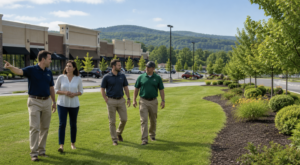
Retail property ownership in Lewisburg, West Virginia, involves more than maintaining storefronts, parking lots, signs, and customer entrances. For owners responsible for larger parcels, shopping centers, roadside commercial properties, undeveloped acreage, or land being held for future expansion, the condition of the surrounding vegetation can affect appearance, accessibility, safety, property use, and long-term maintenance costs.
Lewisburg occupies a distinctive place in Greenbrier County. The city combines an active commercial district with tourism, dining, locally owned stores, professional services, and regional transportation access. The Wikipedia overview of Lewisburg, West Virginia notes the city’s position as the county seat of Greenbrier County and its proximity to major regional routes, including U.S. 219. Those transportation connections help make commercial property visibility and accessibility especially important for businesses serving both local residents and visitors.
For retail property owners with substantial acreage, vegetation should be viewed as part of the property itself rather than an isolated landscaping concern. Routine mowing may be enough for a small commercial lawn, but larger properties can present a very different set of challenges.
Lewisburg Has a Retail Environment Worth Protecting
Lewisburg has developed a reputation that extends well beyond its population size. According to the West Virginia Encyclopedia, the community has a varied commercial base that includes clothing stores, gift shops, restaurants, coffee shops, art galleries, antique stores, and other businesses. Its location near Interstate 64, U.S. 219, and U.S. 60 also helps connect the area with surrounding communities and travelers moving through southern West Virginia. The West Virginia Encyclopedia’s Lewisburg profile provides additional background on the city’s commercial character and development.
That commercial setting places additional importance on the appearance of retail land.
A neglected field behind a store, dense brush beside an access road, vines growing into fencing, or uncontrolled vegetation around an undeveloped section of a commercial parcel can gradually change the way an entire property looks. The storefront itself may be well maintained, yet poorly managed acreage surrounding it can create the impression that portions of the property have been abandoned.
For a retail owner, appearance is not merely cosmetic. Customers form an impression of a location before they ever walk through the door. Clean entrances, visible signage, maintained boundaries, controlled vegetation, and clearly defined property areas contribute to a location that appears active and professionally managed.
Large Acreage Requires a Different Management Strategy
There is a major difference between maintaining a landscaped retail entrance and controlling vegetation across several acres.
Large properties may contain open fields, steep sections, wooded edges, drainage areas, fence lines, access roads, utility corridors, unused parcels, detention areas, and sections that conventional mowing equipment cannot easily reach. Vegetation may also grow at different rates throughout the property depending on sunlight, moisture, slope, previous land use, and soil conditions.
That is why property owners often benefit from a planned approach to Large Acreage Vegetation Management Lewisburg WV instead of treating every overgrown area as an ordinary mowing project.
The objective is not necessarily to make every acre resemble a manicured lawn. On many commercial properties, that would be unnecessary and expensive. The more practical goal is to determine which vegetation should remain, which areas need regular control, where access must be preserved, and which sections may require heavier clearing or specialized maintenance.
A property managed according to its actual use can often be maintained more efficiently than one addressed only after vegetation becomes a serious problem.
Retail Visibility Extends Beyond the Storefront
Visibility is one of the most important advantages a physical retail location can have. A business may invest heavily in signs, building improvements, lighting, parking areas, and exterior branding, yet uncontrolled growth can slowly interfere with those investments.
Brush and small trees can obstruct signs from the roadway. Tall vegetation can make entrances harder to identify. Growth along property boundaries can hide portions of parking areas or buildings. Overgrown roadside sections can also reduce the clean visual transition between a commercial property and the highway or street that serves it.
This is particularly relevant in a destination-oriented community such as Lewisburg. The West Virginia Department of Tourism’s Lewisburg guide highlights the city’s shopping, cultural attractions, recreation, and downtown businesses, including its mix of clothing shops, antique stores, bookstores, and specialty merchandise.
Retail locations are part of that larger visitor experience. The exterior condition of commercial properties influences how an area feels to someone arriving for the first time, especially along routes carrying customers between shopping, dining, lodging, recreation, and other destinations.
Vegetation Management Helps Preserve Usable Commercial Land
Unused acreage has a tendency to disappear from an owner’s daily attention.
A retail business may occupy only part of a larger tract, leaving additional land behind the building or along its perimeter. That acreage may be intended for a future building, expanded parking, a second commercial tenant, storage, another access point, stormwater improvements, or eventual redevelopment.
Allowing those sections to become heavily overgrown can complicate future plans.
Brush can become increasingly dense. Volunteer trees can become established. Invasive growth can spread. Fence lines can disappear beneath vines. Access paths can become difficult to locate. Areas that were once easy to inspect can become inaccessible without clearing work.
Maintaining those sections does not require constant disturbance. It means keeping the property in a condition that allows the owner to understand what is happening on the land and reach important areas when necessary.
The City of Lewisburg Comprehensive Plan includes dedicated sections covering economic development, downtown enhancement, sustainability, transportation, and land use, illustrating how interconnected commercial development and property planning are within the community.
For retail owners, maintaining usable acreage supports that same long-range perspective. Land that is accessible and understood is easier to evaluate when an expansion or development opportunity appears.
Access Around the Property Matters
Commercial acreage contains areas that customers rarely see but owners, contractors, utility crews, inspectors, and maintenance personnel may need to reach.
These can include drainage structures, utility lines, transformers, fences, stormwater areas, rear service roads, loading zones, retention areas, and property boundaries.
Vegetation that is allowed to grow unchecked can make those areas harder to inspect and service. Tall brush may conceal damaged fencing or erosion. Trees and heavy growth can limit equipment access. Dense vegetation can make it difficult to see changes in drainage patterns or identify areas where maintenance may be needed.
Regular management provides something extremely valuable to a commercial property owner: visibility into the condition of the land.
Crews can identify problems more easily when critical areas remain accessible. Property managers can walk or inspect boundaries. Contractors have a clearer route to work areas. Owners can also make more informed decisions about which portions of the property require additional attention.
Lewisburg’s Tourism Economy Raises the Importance of Property Appearance
Retail activity in Lewisburg does not exist independently from tourism.
The Greenbrier Valley attracts visitors for shopping, outdoor recreation, historic sites, arts, dining, events, and nearby destinations. The official Greenbrier Valley shopping guide describes retail opportunities throughout the region, including Lewisburg, and emphasizes the mix of arts, crafts, fashion, antiques, and locally distinctive merchandise available to visitors.
The organization’s Downtown Lewisburg feature also highlights the independently owned stores and dining opportunities concentrated within the downtown district.
That relationship between tourism and commerce makes exterior property conditions significant.
A visitor does not separate a commercial building from its surroundings in the same way a property manager might. The entrance, roadway, field, parking lot, trees, signs, neighboring vegetation, and building often register as one overall impression.
Large-acreage maintenance can therefore contribute to something larger than individual property appearance. Consistently maintained commercial land helps support the visual quality of a business corridor and the broader experience people associate with an area.
Vegetation Control Can Support Safer Property Operations
Vegetation management also has practical implications for day-to-day property operations.
Uncontrolled growth can reduce sightlines where vehicles enter or exit a property. Tall vegetation may limit visibility near internal roads. Dense brush can obscure uneven ground, debris, drainage features, or damaged infrastructure. Vegetation growing against structures, fences, signs, or equipment can also make routine inspections more difficult.
Commercial property owners should pay particular attention to areas where customers, employees, delivery vehicles, and maintenance crews move through the property.
Maintaining clear lines of sight around access points can make navigation easier. Keeping service areas accessible allows maintenance to occur without first clearing a path. Managing growth near parking and loading areas can keep those spaces looking intentional rather than neglected.
The exact level of vegetation control should reflect the property. A highly visible retail frontage may need frequent attention, while distant acreage may require periodic management designed primarily to prevent woody growth and preserve access.
Managed Acreage Can Make Future Development Easier to Evaluate
Retail property needs change.
A business that requires one building today may need additional space several years from now. An owner may decide to lease part of a parcel, construct another building, create a new entrance, enlarge parking, or sell excess acreage.
The Greenbrier Valley Economic Development Corporation emphasizes the region’s transportation assets, available sites, utilities, workforce, and opportunities for business growth. Its Greenbrier Valley economic development overview notes that Interstate 64 connects the region with other major interstate corridors while nearby transportation infrastructure supports access to broader markets.
Existing commercial property can become more useful when owners keep future possibilities in mind.
A parcel covered in years of unmanaged woody vegetation is harder to assess visually. Survey markers and boundaries may be difficult to find. Potential building areas can be obscured. Contractors may need significant clearing simply to evaluate the land.
Keeping acreage under reasonable vegetation control allows owners to maintain a clearer understanding of what they own and how it might eventually be used.
Large Properties Benefit From Consistent Maintenance Rather Than Emergency Clearing
One of the easiest ways for large-acreage maintenance costs to grow is to ignore vegetation until the property can no longer be managed with ordinary equipment.
Grass becomes brush. Brush becomes saplings. Saplings become established trees. Vines spread through fence lines and wooded edges. Areas that once required straightforward maintenance eventually require heavier machinery and substantially more labor.
A regular management schedule can interrupt that progression.
The schedule does not have to be identical for every part of a retail parcel. High-visibility frontage might receive frequent mowing and trimming. Open acreage may need periodic cutting. Brush-prone areas may require targeted management. Wooded boundaries may simply need enough attention to preserve access and prevent unwanted growth from advancing toward developed portions of the property.
WVU Extension’s New River–Greenbrier Valley resource illustrates the region’s close connection between local commerce, land, agriculture, tourism, and community businesses.
Large commercial properties exist within that same landscape. Managing them successfully requires an approach suited to the terrain and vegetation of southern West Virginia rather than a one-size-fits-all maintenance routine.
Professional Appearance Strengthens the Retail Property as an Asset
A retail property is more than the business operating inside the building. The land has value of its own.
Well-managed acreage can make a property easier to show to tenants, buyers, lenders, contractors, and development partners. Clear boundaries, maintained access, visible open areas, and controlled vegetation allow others to understand the parcel more quickly.
That becomes important when opportunities arise unexpectedly.
A neighboring business may be interested in leasing acreage. A tenant may request additional parking. An owner may consider selling part of the tract. A development proposal may suddenly make land that has been unused for years strategically valuable.
A property owner who has kept vegetation under control begins those conversations with a significant advantage. The land is visible, accessible, and easier to evaluate.
Conclusion
Lewisburg’s mix of retail, tourism, transportation access, locally owned businesses, and regional commerce gives commercial property owners good reason to pay attention to the land surrounding their buildings.
For owners of large parcels, vegetation management is not simply about making fields look neat. It can preserve access, maintain roadway visibility, protect the professional appearance of a retail location, keep undeveloped acreage usable, support property inspections, and reduce the likelihood that manageable growth becomes a major clearing project.
The strongest approach is usually a planned one. High-visibility portions of a property can receive more frequent attention while less visible acreage is maintained according to access, future use, terrain, and vegetation type.
Retail properties change over time, and so does the land surrounding them. Keeping that acreage under control gives Lewisburg property owners greater flexibility to maintain, expand, lease, improve, or eventually redevelop their commercial property while presenting a cleaner and more professional image to the customers and visitors who help support the Greenbrier Valley economy.